The Hidden Cost of Generic Software: Why Equine Vet Software Built for Your Specialty Outperforms One-Size-Fits-All Systems
Every equine practice reaches the same breaking point eventually. You are three horses into a lameness exam, trying to sketch a flexion test result on a body diagram that was designed for a Labrador, and you think: this software was not built for what I do.
That moment is not a glitch. It is a design flaw baked into most veterinary platforms on the market today. They were built to serve small animal clinics first, with equine features bolted on as an afterthought. And for practices that live and breathe horses, that gap adds up to real time lost, real revenue left on the table, and real risk during audits or disease outbreaks.
This is the hidden cost of generic software. It does not show up as a line item on your invoice. It shows up in the extra fifteen minutes you spend per exam, the breeding season you nearly lost track of, and the Coggins test you had to dig through email to find.
Let’s break down exactly where general veterinary platforms fall short for equine practices, and why equine vet software built specifically for your specialty changes the equation.
The Problem With “Good Enough” Veterinary Software
Most veterinary practice management systems were built around a simple assumption: patients come to you. A dog or cat is examined in a single exam room, treated, and sent home. That model works fine for small animal medicine. It falls apart the moment you introduce horses, farms, and the realities of ambulatory equine practice.
Generic platforms tend to offer horses as just another species dropdown menu. Underneath that dropdown, the workflows, the templates, and the reporting tools are still built around a cat-and-dog logic. That mismatch creates friction in four areas that matter most to equine practices.
1. Lameness Exams Deserve More Than a Text Box
A proper lameness workup involves grading, flexion tests, nerve blocks, and often a body diagram that needs to reflect the specific limb and gait abnormality you are documenting. Generic systems typically offer one free-text field for all of this. That means vets end up typing out narrative notes instead of using structured, visual tools that make the exam faster to document and easier to review later.
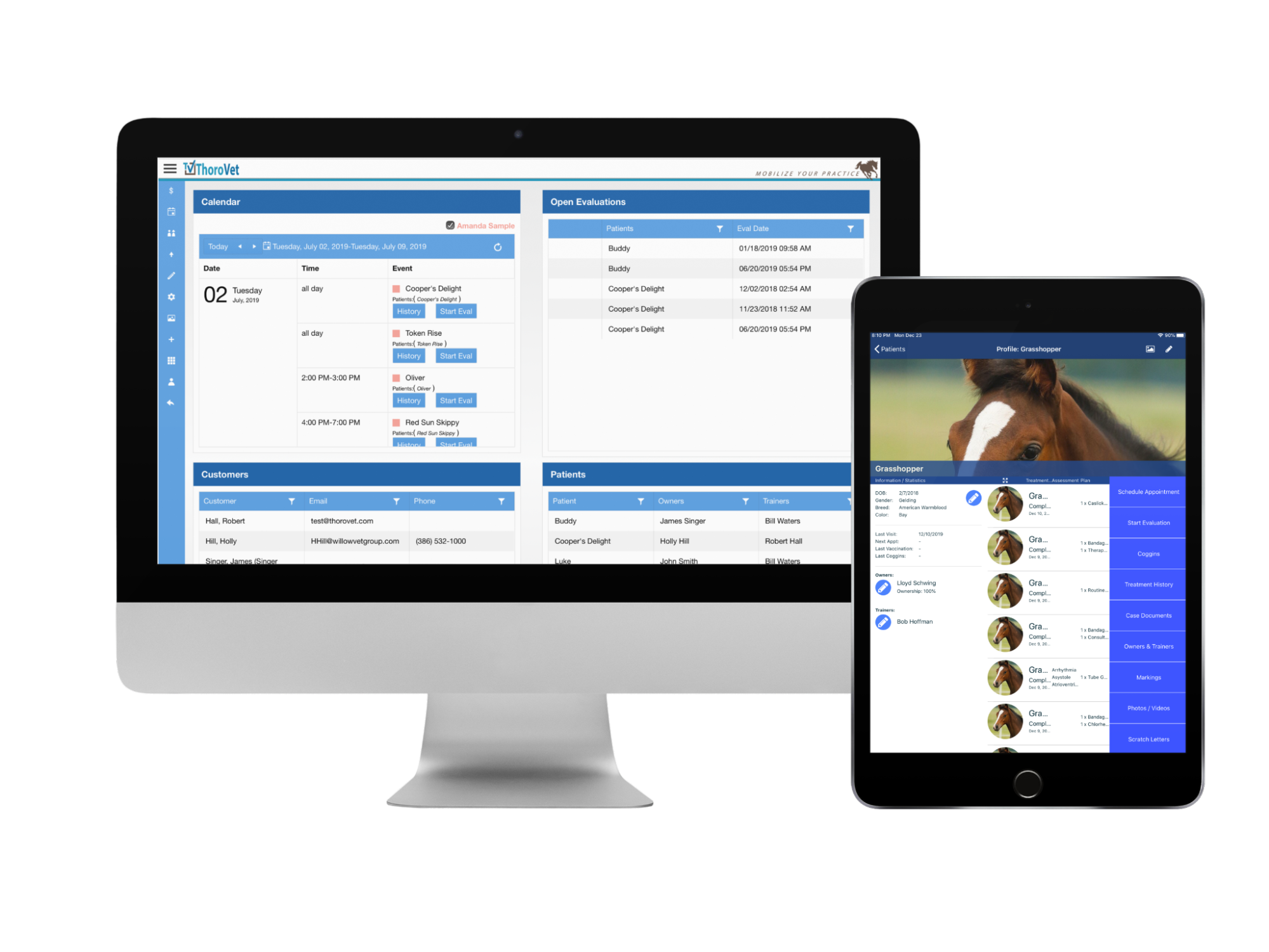
Purpose-built equine vet software gives you interactive body maps, pre-set grading scales, and templates that mirror how you actually think through a lameness exam. That is not a nice-to-have. It is the difference between a five-minute writeup and a fifteen-minute one, multiplied across every lame horse you see in a season.
2. Breeding Records Need a System, Not a Spreadsheet
Equine reproduction work involves tracking cycles, ultrasounds, breeding dates, foaling predictions, and stallion records across an entire season. Generic veterinary software has no concept of a breeding season. Practices end up managing this critical, revenue-driving work in a separate spreadsheet, disconnected from the patient’s actual medical record.
That disconnect creates real risk. A missed cycle date or a foaling window that falls through the cracks is not just an inconvenience. It can mean a lost breeding season for a client and a lost relationship for your practice. Software built for equine reproduction keeps breeding timelines, ultrasound history, and stallion data connected directly to the mare’s chart, where it belongs.
3. Coggins Tracking Should Never Be a Manual Chase
A negative Coggins test is not optional paperwork. It is a legal requirement for interstate travel, shows, sales, and boarding in most jurisdictions. Yet in a generic system, Coggins results often live as a static attachment buried in a file, with no automated way to flag when a test is expiring or missing.
That leaves front desk staff manually chasing down documentation before a show season or a farm audit, which is exactly the kind of task software should be handling automatically. Equine-specific platforms build Coggins tracking in as a core feature, with expiration alerts and instant document retrieval, so your team is never caught scrambling to prove compliance.
4. Multi-Location Farm Billing Is a Different Animal Entirely
Small animal billing is built around a single client walking into a single clinic. Equine practice does not work that way. You might see six horses across three different farms in a single afternoon, each with a different owner, a different billing arrangement, and sometimes a trainer or barn manager who needs a separate invoice entirely.
Generic systems struggle with this because they were never designed for split billing across ambulatory farm calls. Equine vet software solves this by allowing invoices to follow the horse and the farm, not just a single client account, which means your billing team spends less time untangling who owes what and more time getting invoices out the door.
Why This Matters More Than It Seems
None of these gaps are dramatic on their own. No single missed feature will sink a practice. But the cumulative effect is what quietly drains a business. Extra minutes per exam become extra hours per week. A missed Coggins expiration becomes a client who cannot show up to a competition. A billing error on a multi-horse farm call becomes a client who questions your invoice accuracy.
Purpose-built equine vet software is not about having more features for the sake of it. It is about closing the gap between how equine medicine actually works and how the software asks you to document it. When the software matches the workflow, your team spends less time fighting the system and more time doing the clinical and client-facing work that actually grows the practice.
The Real Question to Ask
The question is not whether your current system is functional. Most generic platforms are functional. The real question is how much time, revenue, and risk you are quietly absorbing because your software was built for a different kind of practice.
If lameness documentation, breeding season tracking, Coggins compliance, or farm billing feel harder than they should, that is not a training issue. That is a software fit issue, and it is worth taking seriously.
Ready to See What Equine-Specific Software Actually Looks Like?
If you are tired of working around software that was never built for horses in the first place, it is time for a change. Reach out to ThoroVet to see how equine-specific vet software can streamline your lameness exams, protect your breeding records, keep your Coggins compliance automatic, and simplify multi-farm billing. Your practice deserves software built around how you actually work, not a dropdown menu on a system designed for someone else’s patients.
Frequently Asked Questions
What makes equine vet software different from general veterinary software?
Equine vet software is designed around the actual workflows of horse practice, including lameness exam documentation, breeding and reproduction tracking, Coggins compliance, and multi-farm billing. General veterinary platforms are built primarily for small animal clinics and treat equine features as an add-on rather than a core design element.
Can equine vet software help with Coggins test compliance?
Yes. Purpose-built equine platforms track Coggins test dates, flag upcoming expirations, and make documentation easy to retrieve for shows, sales, or interstate travel. This removes the manual tracking burden from front desk staff and reduces the risk of a client showing up without valid paperwork.
Is switching to specialized equine vet software worth the transition effort?
For most ambulatory equine practices, yes. The time saved on documentation, the reduction in billing errors across multi-horse farm calls, and the improved compliance tracking typically outweigh the short-term effort of switching systems, especially as practice volume grows.