
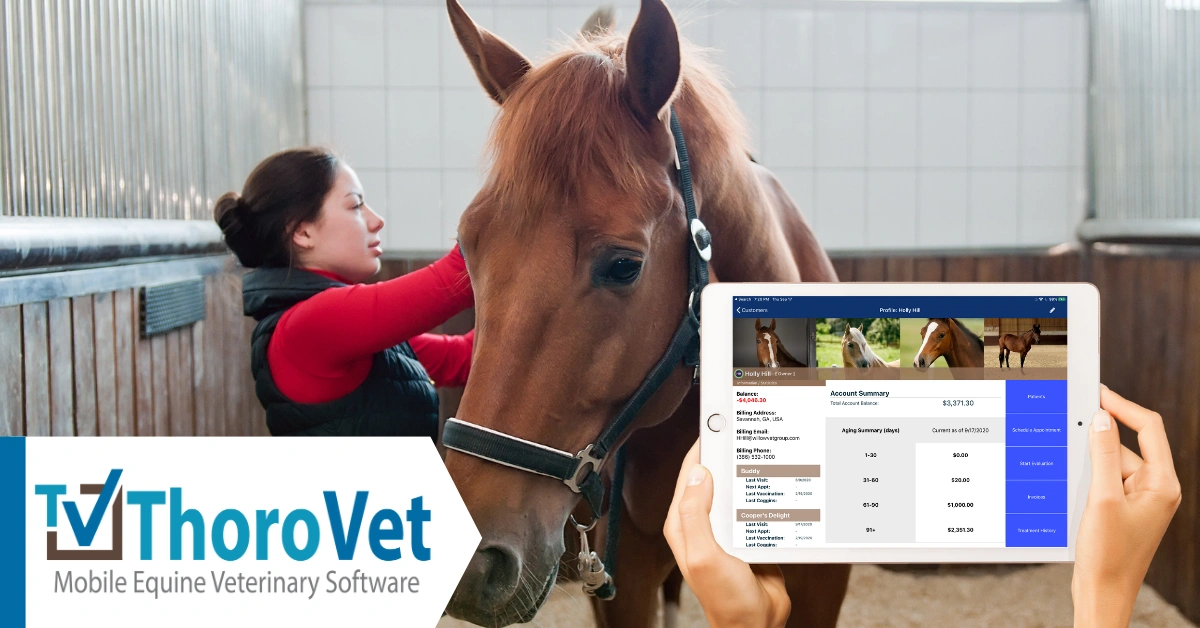
Ask most ambulatory equine vets where their practice data lives and the honest answer is: everywhere. Some of it is on the iPad, some is scribbled on a clipboard in the truck, some is in the office computer, and a surprising amount is in your head. That scattered approach works right up until it does not, usually when a charge goes unbilled, a Coggins reminder gets missed, or you cannot remember which owner agreed to split the bill.
The right veterinary practice management software fixes this by turning scattered information into something you can actually act on. But here is the catch. Most practices use only a fraction of what their system can track. They log the obvious things and quietly leave money, time, and insight on the table. Below is what every equine vet should be tracking, and the high-value items that most practices miss entirely.
Why tracking looks different for equine practices
Equine medicine is not small-animal medicine with bigger patients. You work out of a vehicle, you lose signal on back roads and in metal barns, and a single performance horse might have an owner, a trainer, and an insurance policy all attached to one invoice. Generic veterinary programs were rarely built for that reality, which is why so many equine vets end up tracking less than they should.
Good equine vet software has to handle the mobile, offline, multi-party nature of the work. If it cannot, you naturally stop tracking the things that feel like a hassle, and those are often the things that matter most to your bottom line.
What every equine vet should be tracking
Start with the foundations. If your veterinary practice management software is not capturing these reliably, fix that before anything else.
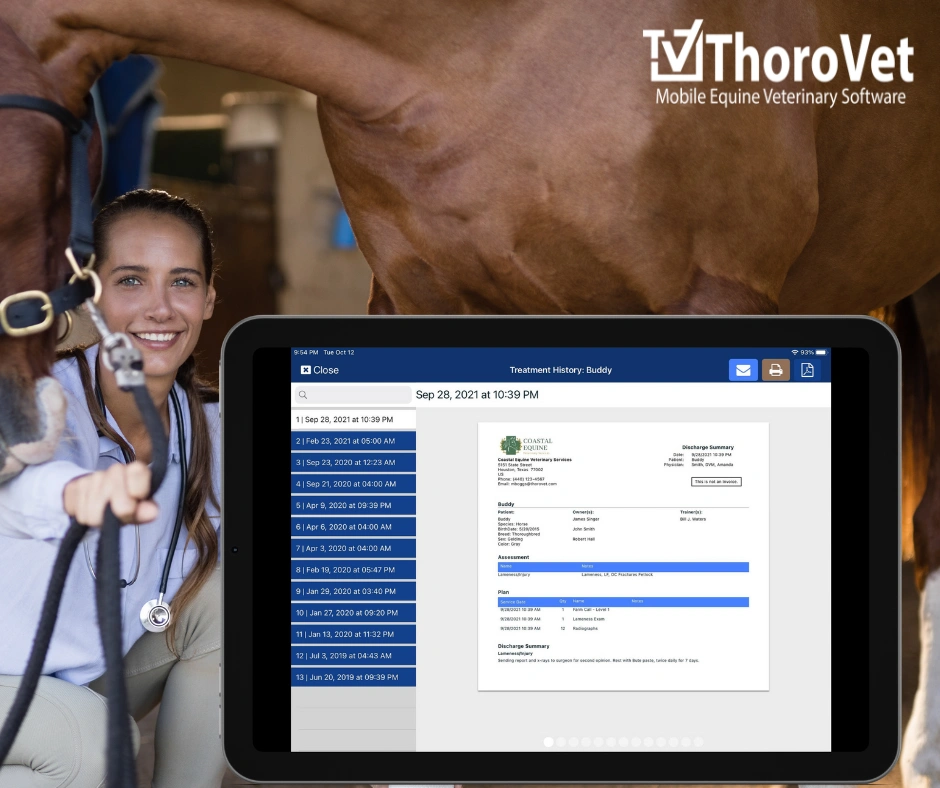
Complete medical records that travel with you. Every exam, vaccine, lab result, radiograph, and note should live in one record per horse, accessible at the side of the animal even with no WiFi. When an owner calls about a horse you treated eight months ago, you should have the full history in seconds, not after a trip back to the office.
Every billable charge, captured at the point of care. This is where revenue leaks fastest. The charge for a tube of dewormer, an extra injection, or a recheck should be recorded the moment it happens, ideally as part of the exam workflow itself, so the invoice builds while you work.
Reminders and recall. Vaccinations, Coggins tests, dental floats, and follow-up visits all run on predictable cycles. Your system should automatically flag when each is due and prompt the client, instead of relying on memory or a wall calendar.
Scheduling and farm call flow. Knowing who you are seeing, where, and in what order is basic, but many practices still run it informally. Centralizing it reduces backtracking and missed appointments.
These are the table stakes. Most decent equine veterinary programs handle them. The difference between a practice that is busy and a practice that is profitable usually comes down to the next section.
What most equine practices miss
Here is where the real value hides. These are the items that even well-run practices routinely fail to track, and each one maps directly to money or risk.
Missed and unbilled charges. Industry estimates suggest up to 20 percent of veterinary services never make it onto an invoice. On a busy farm call day, it is easy to perform a service and forget to record it. If your software builds the invoice as you document the exam, that leakage largely disappears. If you are not measuring missed charges at all, you cannot fix them.
Controlled substance logs. Equine vets carry and administer controlled drugs in the field, and compliance is not optional. Yet many practices still track this manually in a paper logbook that is one coffee spill away from a problem. Your veterinary practice management software should generate controlled substance reports automatically from what you already recorded.
Split and percentage billing. This is uniquely equine and uniquely painful. One horse, multiple owners, or an owner plus a trainer who covers certain costs. If your system cannot split a bill or apply a percentage charge cleanly, your staff is doing it by hand, which is slow and error-prone. Tracking these arrangements properly protects both your revenue and your client relationships.
Profitability, not just revenue. Most practices track how much they billed. Few track what each visit actually earned after drive time, mileage, and product cost. Knowing your revenue per farm call, per vet, or per route is the kind of insight that changes how you schedule and price. This is the single most overlooked number in ambulatory practice.
Accounts receivable aging. Mobile practices are especially prone to letting balances drift. Tracking how long invoices have been outstanding, and acting on the old ones, can recover real cash that is currently just sitting in the field.
Reminder compliance. Sending reminders is good. Knowing how many clients actually booked after a reminder went out is better. That recall rate tells you whether your communication is working and where you are losing repeat business.
Turning tracked data into decisions
Tracking for its own sake is just data entry. The point is what the numbers let you do. When your equine vet software captures charges at the point of care, syncs billing to your accounting system, and reports on the items above, you stop guessing. You can see which services are worth your time, which clients need a nudge, and where revenue is slipping before it becomes a trend rather than after.
Strong reporting also makes tax season, inventory ordering, and growth planning dramatically easier, because the information is already structured and waiting rather than reconstructed from memory.
The practices that thrive are not necessarily the busiest. They are the ones that know their numbers and act on them.
Track what matters with software built for equine practice
If your current system was not built for the realities of ambulatory equine work, you are almost certainly tracking less than you should. ThoroVet is veterinary practice management software created exclusively for equine veterinary practitioners. It works offline on your iPad during farm calls, even with no WiFi, then syncs back to the office once you are connected. It builds invoices as you document exams so charges stop slipping through, handles split and percentage billing with ease, generates controlled substance reports automatically, sends client reminders, syncs seamlessly with QuickBooks Online, and gives you the reporting to see how your practice is actually performing.
It is just what an equine practice needs, without the bloated features built for large hospitals that you will never use.
See how much you have been missing. Book a free demo or call (877) 989-8387 to talk with a team that knows equine practice inside and out.
Frequently Asked Questions
What should equine vet software track that small-animal software does not?
Equine practices need split and percentage billing for shared-ownership horses, offline records and invoicing for farm calls, automatic controlled substance reporting from the field, and equine-specific reminders like Coggins and dentals. Most general veterinary programs are not built for these.
How does practice management software reduce missed charges?
By capturing each service at the point of care. When the invoice builds as you document the exam, products and procedures get billed in real time instead of being forgotten later. This helps close the gap on the roughly 20 percent of services that often go unbilled.
Can equine veterinary programs work without internet on farm calls?
Yes. The best equine vet software is designed to run fully offline on an iPad, letting you record exams, access medical histories, and create invoices in dead zones, then sync everything to the office once you are back on WiFi.